There is one intelligence, the self-organizing force that is the cosmos, that is nature, that is life. To appreciate how AI or Artificial Intelligence is not intelligence, ask a computer to create a chicken, starting with the protective shell, plus a yolk, the nutrient-bearing portion of the egg, and some clear goop, the nutritive and protective gelatinous substance surrounding the yolk. Chickens perform this miracle every day, all over the world without a word. Ask AI to create a chicken. No chicken – no intelligence, just mechanics. Machines that learn are still machines. In the absence of the sacred, living intelligence, learning machines, like thinking humans blind to their true nature, are dangerous.
In its simplest form, the field called Artificial Intelligence combines computer science and robust datasets to enable problem-solving. It also encompasses sub-fields of machine learning which involve algorithms that seek to create expert systems that make predictions or classifications based on input data. A computer playing a good game of chess, mimicking a writer’s style, or analyzing images and making predictions are fine examples. But no chicken, therefore no intelligence, just clever, non-feeling, dead mechanics.
Meredith Whittaker, the president of the secure messaging app Signal notes;
“Get a clue. AI is being deployed as surveillance and is already intrusive beyond anything that most Americans seemingly comprehend.” Learning machines, AI “requires surveillance in the form of these massive datasets that entrench and expand the need for more and more data and more and more intimate collection. The solution to everything is more data, and more knowledge (more surveillance, more control) pooled in the hands of companies.”
“Do we want to resonate with the sacred or the machine?” Catherine Austin Fitts
See: QR Codes, Surveillance + Banks
What’s in a name? Very early, perhaps in the 14th century, intelligence was defined as, “the highest faculty of the mind, capacity for comprehending general truths.” Practically, this meant a quality of thinking, using words, syntax, and logic to describe, share and explain. Hand your father a shell, a yolk, and some clear goop, because he’s supposed to know everything, and ask him to describe how to make a chicken. Then do it. No chicken? Well then, thinking is not intelligence. But, as is often the case, thinking created the definition of intelligence, so quite naturally it praised itself as the “highest faculty of the mind.” The counterfeit shoved the real off the stage and remains firmly in the spotlight. The rest is history.
Mistaking the counterfeit and cunning intellect for living intelligence, and the counterfeit identity this misperception implies is the root of humanity’s great fall, be that Icarus and his hubris, arrogant pride, Dr. Frankenstein’s monster, or the Great Reset.
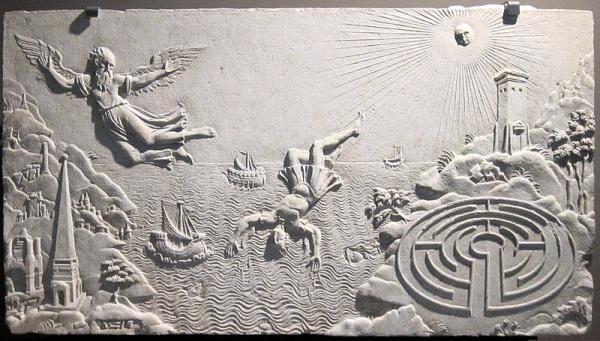
The Fall of Icarus 17th century Musée Antoine Vivenel
The intelligent forces that silently transform yolk and white goop into a chicken do so without symbols, textbooks, priests, formal instruction, or words. No thinking is involved. Intelligence and thought are completely different orders. Empathy explodes in the body the same way as compassion, directly as perception, insight, and action. The mechanism of words and the use of symbols come later, to tell stories, which is not embodied feeling or action. One may invent words to share the direct experience that empathy reveals, but as is often said, the story is not the experience. Thoughts are stories, abstracted into a virtual reality of mental images that appear similar to the experience described but are dead by comparison. Tell a child dying of thirst a story about water and watch what happens.
Like an exploding nebula, the use of words changed the landscape of the mind, pushing out and negating other orders of perceiving, meaning, and knowing. Incrementally the human brain is attuned, like a radio, to one frequency, past knowledge defined by words. This inner change is expressed outwardly as social systems, societies, civilization, and technology. The mental equivalent of the Las Vegas strip extinguished the subjective, nonverbal Milky Way, and all that its stars and mysteries might offer.

Like the narcissist and sociopath, being cut off from our source, meaning living intelligence, our thoughts and behaviors become poisonous to ourselves and the natural world, as our chemicals and technologies are to the earth, the birds, bees, the water, and sky.
The Milky Way does not appear when observing the night sky from the Vegas strip. The cognitive noise is too narrow, intense, and blinding as if our face was covered with VR glasses. To see, feel and re-member what has been lost by our self-imposed sensory deprivation we must take off the VR glasses and walk out into the desert night, with its immense silence, and let our senses re-attune to what is real, no more counterfeits. Below is one of Krishnamurti’s most expressive and challenging descriptions of what “knowing” feels like when words are not defining what we experience.
Silence grew and became intense, wider, and deeper. The brain which had listened to the silence of the hills, fields, and groves was itself now silent. It had become quiet, naturally, without any enforcement.
It was still, deep within itself; like a bird that folds its wings, it had folded upon itself; it had entered into depths which were beyond itself. It was a dimension which the brain could not capture or understand. And there was no observer, witnessing this depth.
Every part of one’s whole being was alert, sensitive but intensely still. This new, this depth was expanding, exploding, going away, developing in its own explosions; out of time and beyond space.
(Time and space being thoughts, names, concepts.)
Krishnamurti’s Notebook
“And there was no observer, witnessing this depth,” is the critical phrase, the observer being the trick word-thoughts play on the mind. Thought is an actual process in the brain and nervous system, and this process is so fast and powerful that it creates an image of a thinker that is assumed to be the source of thoughts. Having no observer, no image of a thinker witnessing negates this false impression that there is a thinker independent of thought. Believe me, I appreciate how challenging this mental riddle is to see in one’s self. But we must see it.
Not having words define our experience implies opening and discovering other ways of knowing, where direct perception reveals the one real, organic intelligence, expressing, moment by moment as insight, as spontaneous empathy, as kindness, and direct action in the world, unfettered by the mechanical prejudgments that words impose and demand. The one intelligence that transforms shell, yolk, and goop into a chicken expresses as you, this moment, creatively. Sure, words may be useful tools to promote and enhance how we express and share this direct experience, as Krishnamurti does above, but that expression is not in response to, or defined by words, by beliefs, moral rules, or “what will they think of me?” All these are the dominion or “the state of the observer,” not “the state of living insight-intelligence.” Similar to a light switch in a room, one “state” negates the other.
The silent mind, free from the prejudgments words and thoughts impose, suddenly becomes explosively awake, sensitive, alert, overflowing with energy, attention no longer weighed down, limited, and constrained by preconceptions, opinions, and judgments. This silence is like walking away from the Las Vegas strip and embracing the Milky Way for the first time.

Imagine experiencing your child with this silent explosive attention and energy. What would you see? What would you feel? Or your husband or wife, or the wind blowing over the seashore, the light shimmering as rich hues of glowing red and purple fading as the sun sets. Spontaneous, silent, vibrant, and intense ecstasy, as a way of being in and with the world.
The work now is in the realm of immanence (the divine encompasses or is manifested in the material world). What is being lost today in Western civilization is the development of the soul or subjective capacities. Which can lead us to our primary source of understanding within the mind, the imagination, and the emotions. The human-earth relationship can teach us to recover these through our uniquely human ability to reflect on the magnificence of a sunrise, the miracle of a hummingbird, the profusion of blossoming flowers, the awesome sight of a waterfall, the lightning and thunder of great storms. Through these outer experiences comes the development of our inner development, and our creativity.
We have to awaken specific human faculties in our deeper capacities; we have more profound dimensions than we realize. We cannot endure living on the earth without a sacred context. Earth gives unique expression of itself in its rocks and crystalline structures, and in the variety and splendor of living forms, until humans appear as the moment in which the unfolding universe becomes conscious of itself… We bear the universe in our beings as the universe bears us in its being. The two have a total presence to each other and to that deeper mystery out of which both the universe and ourselves emerged…
Thomas Berry
And then the phone buzzes and we are trapped again.
M
See David Bohm
The Limitations of Thought
Knowledge and Insight
Insight with Joseph Chilton Pearce